
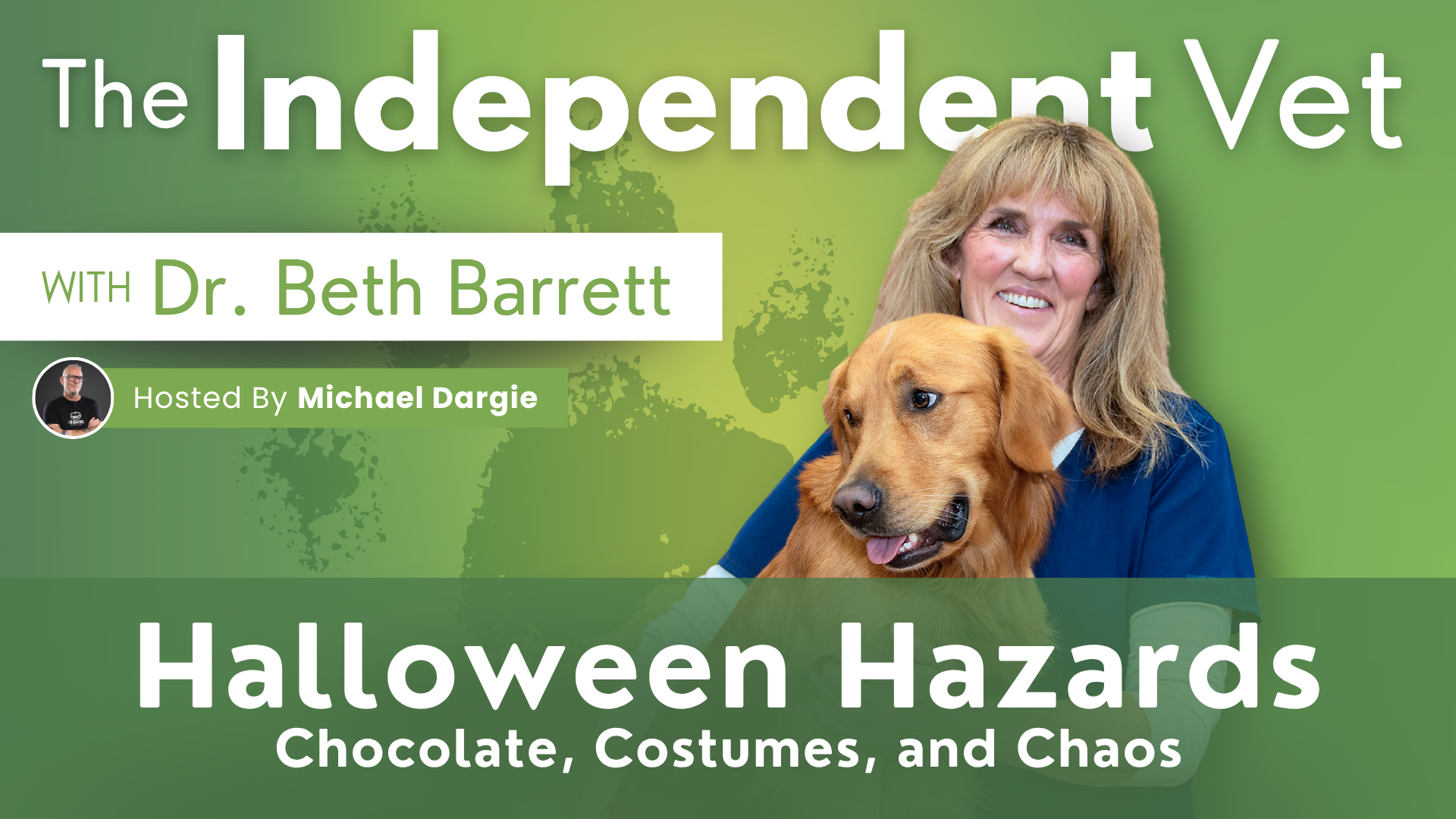
Season 1 · Episode 14 Run time: about 22 minutes Host: Michael Dargie Featuring: Dr. Beth Barrett, DVM
What’s in the Candy Bowl, Who’s Enjoying the Costume, and How to Survive the Doorbell
Halloween is Dr. Beth’s birthday. Some would say that makes her a witch; she figures if the broom fits, she can own it. It also means she has spent a lot of October 31sts thinking about what ends up at dog-nose height by the front door.
Michael is between dogs right now, but he remembers his own Halloweens as equal parts chaos, excitement and drama. So this episode is the pre-game: what in the candy bowl is dangerous and how much it takes, how to tell whether your pet is enjoying the costume or just tolerating you, and how to get through a night of doorbells without anyone bolting into the dark.
Chocolate comes first, and Dr. Beth is clear that not all of it is equal: dark is worse than milk, a big dog can handle more than a small one, and she has seen more chocolate cases at Christmas than at Halloween. But the thing vets have in the back of their minds every time candy is out is xylitol, the artificial sweetener in sugar-free gum, some candy, and some peanut butter. She describes a Labrador carried into the clinic mid-seizure after a small bag of gum. Then the one nobody thinks about: the wrappers themselves, which mash together into a very effective plug.
From there it’s decorations (that fake spider web behaves like a rope inside an intestine), a day-in-the-life story about a dog named Belle, twelve chocolate chip muffins and a litter box lined with a plastic bag, and a kitten in a ballet tutu who was, in Dr. Beth’s words, “kidbroke” and loved every minute of it. Costumes are fine for the pets who are into them. For the ones who aren’t, the back bedroom with a bone is a perfectly good Halloween.
The idea Dr. Beth keeps coming back to: we have to be their advocates. Plan ahead, respect the animal who wants no part of it, and remember that tired dogs, like tired kids, are good dogs.
Chapters & Timestamps
|
Time |
Segment |
|
00:00 |
Cold open, disclaimer & welcome — Halloween is Dr. Beth’s birthday (“if the broom fits”) |
|
01:49 |
Chocolate: what’s in it, dark vs. milk, and why the size of the dog matters |
|
03:15 |
What happens next: getting it out fast, apomorphine and activated charcoal |
|
06:04 |
Xylitol — the one vets worry about most |
|
07:17 |
It’s not just the candy: wrappers, fake cobwebs and obstructions |
|
09:12 |
The bowl is empty and the dog looks guilty — Belle and the twelve muffins |
|
11:27 |
Costumes: kidbroke pets, stress signs and Doctor Dog |
|
13:12 |
Be their advocate: the back-bedroom-with-a-bone plan |
|
14:21 |
Candles, glow sticks, and help for the pet who panics every year |
|
16:18 |
Cat backpacks and why tired dogs are good dogs |
|
18:55 |
Myth or Muzzle? — Any chocolate at all is an emergency |
|
19:40 |
Ask Dr. Beth — Shredded wrappers all over the living room |
|
20:48 |
Outro |
Myth or Muzzle? (18:55)
The claim: “If a dog eats any chocolate at all, it’s a life-threatening emergency.”
Verdict: MYTH BUSTED. (With a catch.)
Dr. Beth calls this one a myth, because dose is the whole story. There is an amount of chocolate that will be toxic, and it depends on the size of the dog and the type of chocolate: her Lab Zip stealing a bite of her chocolate bar is not a problem, but an entire dark chocolate bar could be. The catch is that “not every case is an emergency” is not the same as “don’t worry about it.” Work out how much was there and how much you think the dog ate, call someone, and if it’s a reasonable amount, get it out of them. Still worth paying attention to, every time.
Ask Dr. Beth (19:40)
The question (from the letter bag, read by Michael): “I woke up to shredded wrappers all over the living room. I have no idea how much my dog ate or when. What do I do?”
Dr. Beth’s answer, in short:
-
Take them to the vet. Unknown amount and unknown timing means the vet decides, not you.
-
The clinic will try to get rid of whatever is still in there, and may want an X-ray.
-
If the dog is already vomiting on its own, that can be a sign of an obstruction. Get them seen.
-
Bring the wrappers. Knowing what was eaten, and whether any of it was sugar-free with xylitol, tells the vet a lot more about what to worry about.
-
Dr. Beth would rather deal with it early than go down the road to surgery later.
Michael’s takeaway: Halloween is a great night for parents and kids and a confusing one for pets. A little pre-planning covers most of it: exercise the dog (tired dogs are good dogs), and if you know they’ll be stressed, give them somewhere to hide out. Plan for it.
Key Takeaways
Not all chocolate is equal, but avoid all of it. Dark chocolate is worse than milk, and the problem is the caffeine and theobromine inside it, both stimulants in a dog. The signs are panting, drooling, sometimes nausea, and a jittery dog that, as Dr. Beth puts it, looks like her on four cups of coffee.
The size of the dog decides how worried to be. A big dog can manage more chocolate; a little dog can show toxicity signs on very little. There are chocolate calculators online to help you work out whether what your dog ate is likely to be a problem, and your vet can walk you through the math.
Christmas is worse than Halloween. Dr. Beth has seen more chocolate toxicity at Christmas than at Halloween. The rule is the same for any time there’s a lot of candy around the house.
Getting it out fast is the goal. Chocolate vomits up easily, so the clinic will usually give an injection (apomorphine) that causes almost immediate vomiting, then activated charcoal to stop the rest from being absorbed. If an emergency clinic is within striking distance, go.
Xylitol is the one vets think about every time candy is out. It’s the sweetener in sugar-free gum and candy, and in some peanut butters. It is terribly toxic to dogs in small amounts: Dr. Beth remembers a Labrador arriving mid-seizure after a small bag of about ten pieces of gum. Check the label on your peanut butter before you use it to hide a pill.
Raisins are a kidney hazard. Dogs will eat them, and they can cause severe kidney disease. Oatmeal raisin cookies are not for dogs.
Sometimes the container is the problem. Wrappers smell like candy, kids drop them everywhere, and a wad of them mashed together makes a very effective plug in the intestine.
Fake spider web is a surgical case waiting to happen. It acts like a rope inside the gut; the intestine bunches up over it or telescopes inside itself (an intussusception). Dr. Beth has done two obstruction surgeries in the last two weeks on dogs and cats that ate things they shouldn’t. Cats especially love to chew it. If your pet is the type to get into decorations, decorate accordingly.
Glow sticks and candles: cats first. Playful cats are drawn to little lights, and a chewed glow stick is a plastic foreign body plus whatever is inside it. Michael’s household has switched to electric tea lights in the jack-o’-lanterns.
Know your animal before the costume goes on. Some pets are “kidbroke,” raised with little kids and happy to wear anything, like the black kitten who visited the clinic in a ballet tutu, or Dr. Beth’s golden retriever who went as Doctor Dog in a lab coat and booties and wagged the whole way. If yours resists, salivates or pants when you put it on, that’s your answer. Don’t drag a dog down the street in a pumpkin costume that doesn’t want to be there.
Be their advocate. Strangers in masks, constant doorbells and a houseful of people are terrifying for some animals. They don’t have to be part of it. A back bedroom with a bone to chew is a perfectly good Halloween, and it keeps a friendly dog from overwhelming the kids and a nervous cat from leaving through the window.
For the pet who truly panics, talk to your vet ahead of time. There are medications for event stress, including an oral gel given a couple of hours before the doorbells start. Which one, and whether your pet needs it, is a conversation with your vet, not a Halloween-morning decision.
Tired dogs are good dogs. Before the chaos starts, get the dog out for real exercise and give the cat a proper play session. Burning off the energy ahead of time is prevention, and prevention is the theme of the whole episode.
Resources Mentioned
-
Barrett Veterinary Practice — barrettvet.ca · 403.860.5763 · drbarrettvet@gmail.com · @barrettveterinarypractice
-
Chocolate toxicity calculator:
-
Calgary Area After-hours emergency clinics:
Alpine 24/7 Pet Hospital 5707 Macleod Trail SW, Calgary 403-212-4008 Website
VCA CARE Centre 7140 12 Street SE, Calgary 403-520-8387 Website
VCA Calgary North Animal Hospital 4204 4 Street NW, Calgary 403-277-0135 Website
Paramount 24 Hour Animal Hospital 5111 Northland Drive NW, Unit 4110, Calgary 403-300-9111 Website
Trinity Hills 24 Hour Pet Hospital 240 Na’a Plaza SW, Calgary 403-233-2888 Website
Petzoic Vet Hospital 11501 Buffalo Run Blvd., Unit 101, Tsuut’ina 403-453-9111 Website
Connect with The Independent Vet
-
Website: barrettvet.ca
-
Instagram: @barrettveterinarypractice
-
Email: drbarrettvet@gmail.com
-
Phone: 403.860.5763
Got a question for Dr. Beth? Send it in — it might be featured in a future Ask Dr. Beth segment.
Disclaimer
This podcast is for educational and informational purposes only. Always consult your veterinarian for medical advice specific to your pet.
About the Author: Roxane Wenstrom