
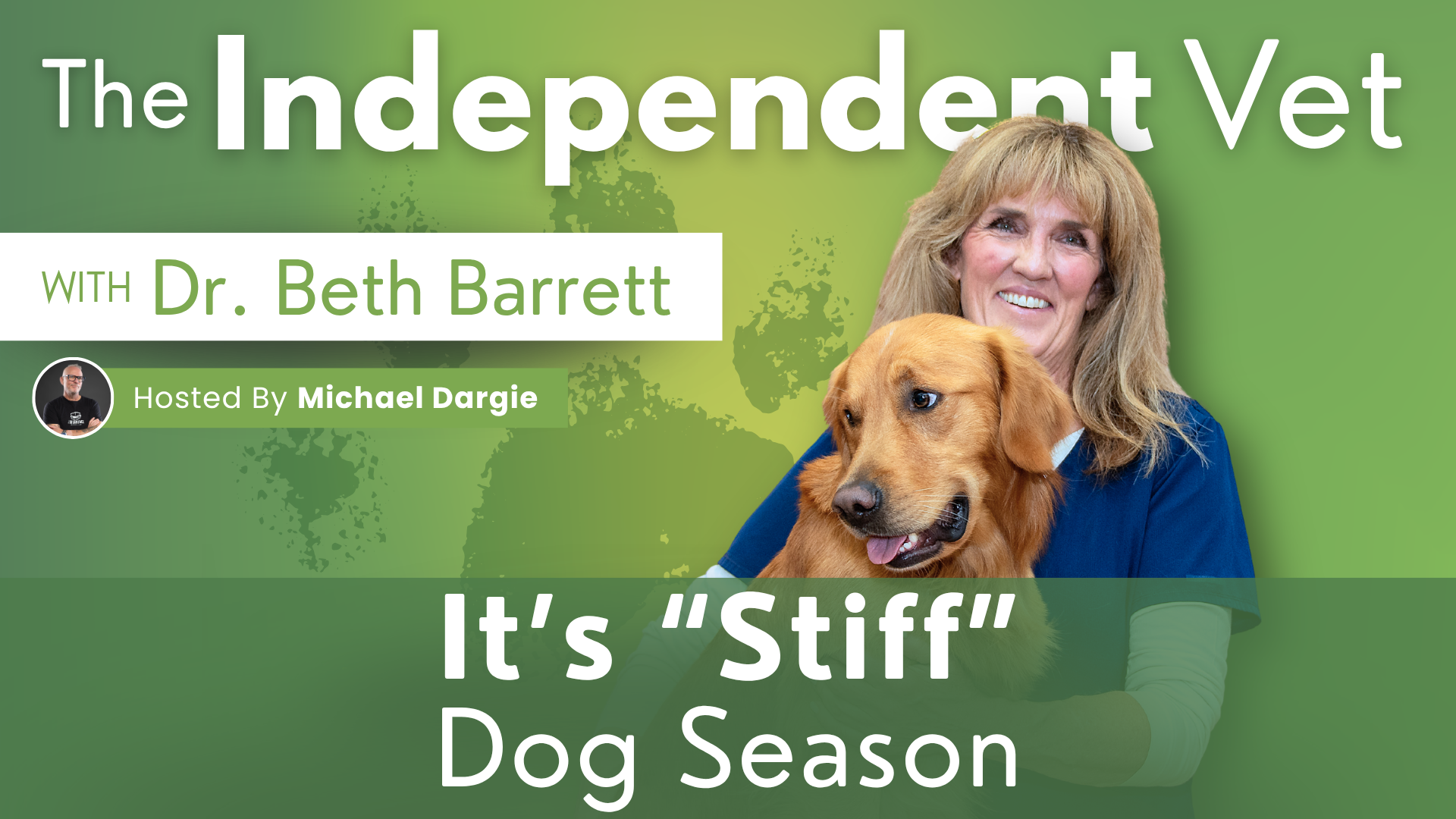
Episode 13 — It’s “Stiff” Dog Season
Season 1 · Episode 13 Run time: 35 Minutes Host: Michael Dargie Featuring: Dr. Beth Barrett, DVM
Michael is arthritic. It takes him about an hour every morning to get moving, and the first cold morning of the year is when he feels it most. He remembers his dogs doing the same thing: slower on frosty mornings, careful getting up. Like most of us, he figured they were just getting older.
Dr. Beth sees arthritis every day, in dogs, cats and horses, and she wants to put a muzzle on “just getting older.” The stiffness you’re seeing is pain. Cold weather doesn’t cause it, but it brings it out: less moving, less blood flow, more time curled up on a cold floor. Motion is lotion.
Her number-one prescription isn’t a drug. It’s weight. Extra weight makes joints work harder and makes inflammation worse, and a leaner pet is cheaper to feed, moves more, and gets more out of every other treatment. She tells the story of a 39-kilo dog who came in for joint surgery and, a year later, weighed 19 kilos. That dog spent the next eight years spry and happy.
From there it’s the rest of the toolbox: shorter walks but more of them, a bed that stays padded, foam steps for the bed, marine omega-3s, the joint supplements she actually trusts, and the newer medications, including the monthly injections Librela for dogs and Solensia for cats. Dr. Beth’s own dog Sprint went on it at 13 and was galloping around like a puppy within two months. Her line for every listener: “That wasn’t old. That was pain.”
And cats. Mabel and Charlie get a mention, because cats have far more arthritis than anyone used to think.
Chapters & Timestamps
| Time | Segment |
|---|---|
| 00:00 | Cold open, disclaimer & welcome — “I know nothing about this other than I am arthritic” |
| 01:33 | What osteoarthritis actually is |
| 03:31 | The first cold morning: why cold makes stiff joints stiffer |
| 05:26 | The number-one prescription: weight (and why fat is inflammatory) |
| 09:19 | Exercise, warmth & bedding: shorter walks, more of them |
| 13:06 | Cats get it too — and the stiffness owners file under “just old” |
| 16:49 | Omega-3s, joint supplements & teaching the bed steps |
| 21:34 | The medicine toolbox: multimodal pain control |
| 26:06 | Monoclonal antibodies: Librela, Solensia & Sprint |
| 29:10 | Myth or Muzzle? — He’s not in pain, he’s just old |
| 31:44 | Ask Dr. Beth — Can I just give him an Advil? |
| 34:17 | Outro |
Myth or Muzzle? (29:10)
The claim: “He’s not in pain, he’s just old. Slowing down is normal — dogs get stiff, that’s just what happens.”
Verdict: MUZZLE IT.
Dr. Beth: she hears a version of this in the exam room constantly — “he’s not painful, he’s just stiff” — and her answer is that stiffness is pain. Think about how your own stiff morning feels; it’s discomfort, and animals are simply more stoic about it than we are. The signs owners read as aging are the ones she reads as arthritis: a long stretch every time they get up, a pause before the stairs, a dog who used to jump into the back of the minivan and now stops and waits for a lift, a dog who hangs back on walks or seems less social. Her own dog Sprint taught her the lesson at 13, when a monthly injection turned “an older dog” back into one who galloped. She isn’t promising puppies, and aging is real, but pain is a component in far more of these animals than anyone realizes, and it’s one of the most manageable things she sees. She doesn’t want her dogs living like that, and she has a big toolbox to make sure they don’t.
Ask Dr. Beth (31:44)
The question (from a listener): “My dog is clearly stiff and I’ve got a bottle of Advil in the cupboard. Can I just give him one? He’s a big dog.”
Dr. Beth’s answer, in short: no — not ever.
- Ibuprofen (Advil) is a risky drug in a dog’s stomach. Dogs are very sensitive to its gastrointestinal effects, and Dr. Beth has seen a dog die from perforated gastric ulcers caused by it.
- Size doesn’t make it safe. A big dog is still a dog.
- Never give a cat acetaminophen (Tylenol). Cats lack the enzyme to break it down and it is lethal for them. Tylenol can be used in dogs at a vet-prescribed dose — but that’s a decision for your vet, not the medicine cabinet.
- There are better, pet-specific options. Call the clinic and check before you give anything.
- Pain management doesn’t have to be expensive. If budget is tight there are still things to try, and if you aren’t getting the answers you want, pain specialists exist.
Michael’s takeaway: Go see your vet. Talk to your vet. And the bigger one, the thing that changed the game for him: he’s had dogs that “just got old,” and he didn’t realize they were in pain. Rule that out before you accept the slowdown — there’s a very good chance something can be done about it.
Key Takeaways
Stiffness is pain. The thing owners describe as “he’s just stiff” is the thing vets call discomfort. Animals are stoic and adapt around it, so the slowdown gets mistaken for a personality change or plain old age.
Cold doesn’t cause arthritis — it reveals it. Warmth increases blood supply to joints. Cold means less movement, less circulation, and pets holing up inside. The arthritis was there in July too, hidden by warm muscles and long evenings.
Weight loss is the number-one prescription. Ask any pain specialist for their top drug, Dr. Beth says, and the answer is weight loss. Even a 6 to 8 percent drop in body weight can produce a statistically significant reduction in pain.
Fat is inflammatory tissue. It doesn’t just load the joints; it produces inflammatory chemicals. Any disease ending in “-itis” is an inflammatory process, and reducing fat reduces inflammation. It’s also the cheapest fix on the list, because you’re feeding less.
Shorter walks, more of them. A few ten-minute walks a day beats one heroic weekend hike. The goal is blood flow to the joints without leaving the dog struggling the next morning.
“Does he warm out of it?” Worse after rest and better once moving is classic arthritis — it’s one of the questions Dr. Beth asks before she even X-rays. Soft-tissue injuries do the opposite and get more painful the longer the animal goes.
A bed that stays padded. No cold floors, and no cushy-looking bed that flattens so they can still feel their hip through it, like a sleeping bag on the ground. Memory foam can be good. Skip the plug-in heating pad — a sleeping dog can’t tell you it’s too hot — and look at body-heat-reflecting fabrics like Back on Track instead.
Teach the steps. Jumping off a two-and-a-half-foot bed is hard on the elbows; jumping up is hard on the knees and hips. A foam step from the furniture store solves it, but dogs have to be taught to use it. Make it a game.
Omega-3 means marine. Fish oil (or algae oil) is what works for joints. Flax, coconut and camelina oil don’t convert well in animals, or in people. Arthritis needs a higher dose than puppy brain development does, and fish oil also softens the stomach side effects of anti-inflammatories, so there’s really no reason not to use it.
Be picky about joint supplements. Regulation is loose, and many products “may have been near a bottle of glucosamine” without containing much. Dr. Beth sticks to a couple she trusts. The evidence for supplements is thinner than for weight loss and lifestyle, but they can be part of the program.
Multimodal pain control: aggregate the gains. When Dr. Beth graduated the answer was one pill. Now it’s weight, oils, walk changes, bedding, supplements and medication layered together, because the cumulative benefit is far more effective than any single lever.
The toolbox is bigger than it used to be. Anti-inflammatories like meloxicam, carprofen and Previcox remain the backbone where kidneys and liver allow. Gabapentin and pregabalin help with nerve pain, amantadine prevents pain wind-up, and low-dose ketamine can be given monthly for chronic pain.
Monoclonal antibodies changed the game for older pets. Librela (dogs) and Solensia (cats) are monthly injections under the skin that block the nerve growth factor driving arthritic pain. They’re an option for animals who can’t take anti-inflammatories because of kidney problems.
Run a two-week trial. If a short course of treatment visibly changes your pet in two weeks to a month, that wasn’t aging — that was pain. Rule it out before you accept the slowdown.
Cats have more arthritis than anyone thought. A study that X-rayed every cat through a clinic found a huge number of undiagnosed cases. Weight is a big driver: a barn cat hunting for its calories is far leaner than a house cat with food made easy.
Resources Mentioned
- Barrett Veterinary Practice — barrettvet.ca · 403.860.5763 · drbarrettvet@gmail.com · @barrettveterinarypractice
- Omega-3 dosing for arthritic joints — Dr. Beth asked on air for this to go in the show notes: 100 to 150 mg/kg of combined EPA and DHA from a good-quality marine-source fish oil. Confirm the right dose for your pet with your veterinarian. (Pending Dr. Beth’s sign-off — see producer flags.)
- Back on Track — Ceramic-fibre blankets, pads and wraps that reflect body heat back as far-infrared warmth. Dr. Beth’s preferred alternative to a plug-in heating pad. (Web link pending — see producer flags.)
- Joint supplements Dr. Beth uses — Two named on air; the captions garbled both. Likely Dasuquin and 4CYTE, the Australian sport-horse supplement now used in dogs, cats and people. (Names to confirm — see producer flags.)
- Librela (bedinvetmab) for dogs · Solensia (frunevetmab) for cats — Monthly anti-nerve-growth-factor injections given at the clinic. (Web links pending — see producer flags.)
- Previous episodes referenced — Omega oils (“we’ve talked about those in the past”), weight and inflammation (“I’ve mentioned that in other chats”), and feline arthritis (“I may have mentioned this once before”). (Confirm which episodes — see producer flags.)
Connect with The Independent Vet
- Website: barrettvet.ca
- Instagram: @barrettveterinarypractice
- Email: drbarrettvet@gmail.com
- Phone: 403.860.5763
Got a question for Dr. Beth? Send it in — it might be featured in a future Ask Dr. Beth segment.
Disclaimer
This podcast is for educational and informational purposes only. Always consult your veterinarian for medical advice specific to your pet.
About the Author: Roxane Wenstrom