
Episode 10 — Keeping Your Cat Mentally Fit
Season 1 · Episode 10 Run time: 44:44 Minutes Host: Michael Dargie Featuring: Dr. Beth Barrett, DVM
Michael has been a cat person his whole life, and for most of it he assumed cats basically ran themselves. Food in the bowl, litter in the box, sunbeam for napping, everyone’s happy.
Turns out that under the sleepy little loaf is a tiny tiger — an animal hardwired to spend its day stalking, climbing, and pouncing. And when that brain has nothing to do, it finds its own entertainment.
In this episode, Dr. Beth Barrett makes the case that mental fitness isn’t a luxury add-on to cat ownership. It’s medicine. A high percentage of the cats she sees in the clinic come in for behavioural reasons, and most of those behaviours trace directly back to a hunting instinct with nowhere to go. Some of those cats never make it home — urinary marking is one of the leading behavioural reasons cats are surrendered to shelters.
The good news: the fix is rarely expensive, and often free.
 Dr. Beth and Michael cover why “just setting a bowl of food down” does cats a disservice, how to read the behaviours that boredom quietly causes, and how to build a cat’s world upward instead of outward. They get into catios, harness walks, why you should never leave a cat tethered outside, the litter box formula (cats plus one, in different rooms), why water belongs away from food, and a study on feline arthritis that changed how Dr. Beth thinks about weight.
And along the way: Snack Hunter, a mouse in a recording studio, six birds down a chimney, and a cat named Steve who learned to operate a touch-activated kitchen tap.
Chapters & Timestamps
| Time | Segment |
|---|---|
| 00:00 | Cold open & disclaimer |
| 00:34 | Welcome — the tiny tiger asleep on the keyboard |
| 02:36 | Section 1: Why a safe, fed, warm cat still needs a job |
| 02:49 | Having everything handed to you is not a recipe for happiness |
| 03:56 | The world’s greatest hunter — and the bowl that takes the job away |
| 04:46 | “Snack Hunter”: Michael’s freeze-dried salmon scatter |
| 05:35 | Why so many feline vet visits are behavioural, not medical |
| 05:54 | What boredom actually looks like |
| 06:03 | Destructive scratching (and why scratching is hunting maintenance) |
| 06:47 | Overgrooming, bald bellies, and stress dermatitis |
| 07:50 | Urinary issues and marking — the biggest one |
| 08:28 | Play aggression: the pet that turns into a bite |
| 09:52 | Overeating, counter surfing, and the 3 a.m. yell |
| 10:47 | The hard part: cats surrendered and euthanized over litter box issues |
| 11:09 | Charlie, Mabel, and the puzzle feeder Charlie cracked first |
| 13:10 | A mouse in the recording studio |
| 14:21 | Why hunting play looks cruel — and isn’t |
| 16:30 | Section 2: Build up, not out |
| 16:32 | Never punish a cat for being a cat (six birds, one open flue) |
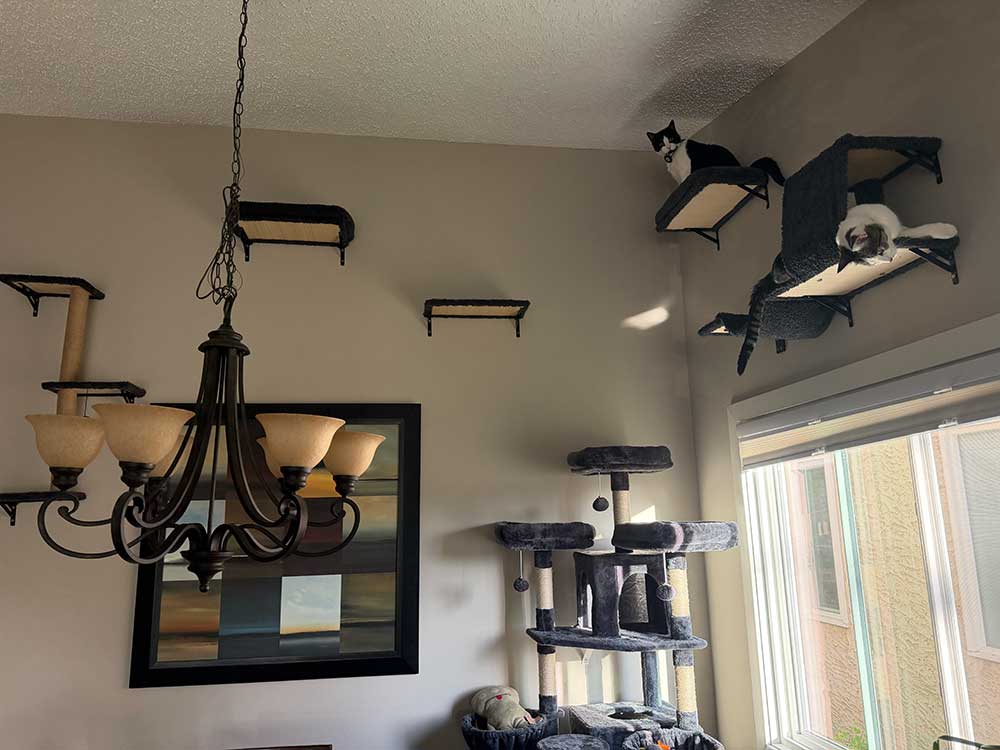
| 17:41 | The vertical world: cat trees, wall steps, window shelves, bird TV |
| 20:21 | Small home? The walls are real estate |
| 20:58 | Vertical space in multi-cat homes: exits, height, and keeping the peace |
| 21:48 | Section 3: The outdoors, safely |
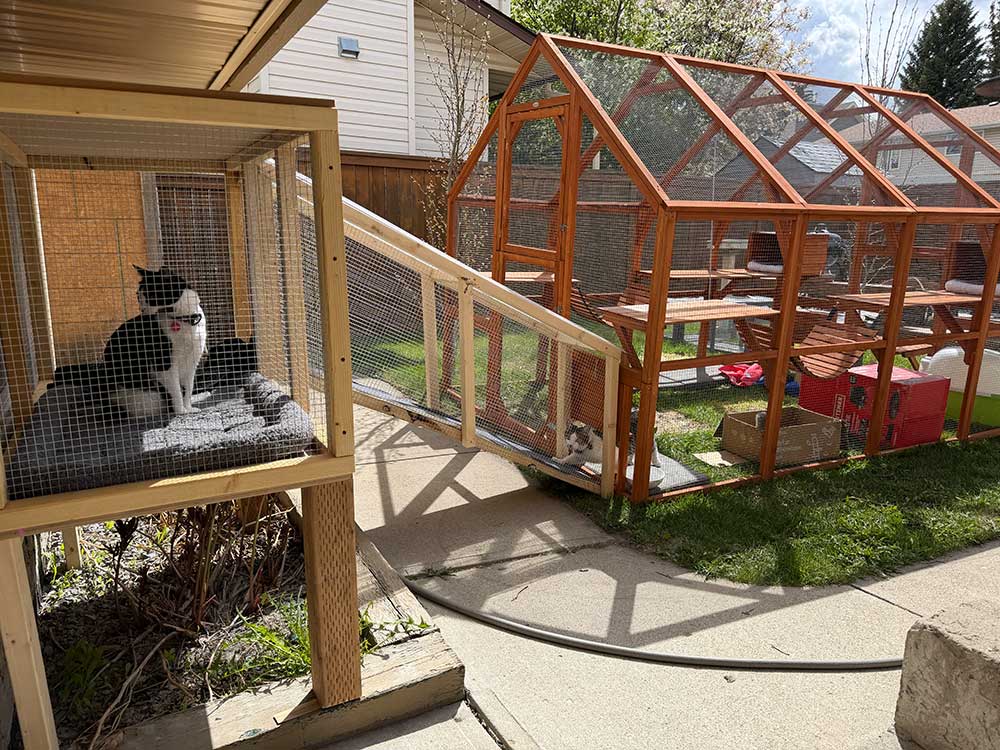
| 21:53 | Catios and the Alberta predator problem — coyotes, bobcats, raptors |
| 22:39 | The CE talk: outdoor access reduces behavioural problems |
| 23:02 | Harness walks, and the client who walks his Bengals |
| 23:58 | Michael’s tunnel system (and the birdbath maze) |
| 26:08 | Never leave a cat tethered outside |
| 26:50 | Breakaway collars and AirTags |
| 27:04 | Feeding, litter, and water: the three big levers |
| 27:33 | Litter box math: cats plus one, different rooms, different litters |
| 28:31 | Food puzzles — the feeder, the ice cube tray, the empty pop bottle |
| 31:01 | The arthritis study, and why lean cats matter |
| 33:13 | Water away from food; running water; Steve and the touch tap |
| 36:11 | It doesn’t have to be complicated |
| 37:22 | Myth or Muzzle? |
| 38:19 | Ask Dr. Beth — “My cat turns into a maniac at 3 a.m.” |
| 39:46 | Rotate the environment; don’t just keep adding to it |
| 40:39 | Michael’s takeaways |
| 42:05 | Enriched cats sleep on your knees |
| 44:00 | Outro |
Myth or Muzzle? (37:22)
The claim: “Cats are independent loners. They entertain themselves and don’t really need our involvement.”
Verdict: MUZZLE IT.
Dr. Beth: cats can be independent, but they have complex social needs. Even a cat who has no interest in sitting on your lap still needs enrichment, engagement, and stimulation to live a good cat life. You don’t turn a cat loose in your house and consider the job done.
Ask Dr. Beth (38:19)
The question: “My cat turns into a maniac at night — sprinting around, yelling, knocking things off the dresser at 3 a.m. We’re exhausted. How do we make it stop?”
Dr. Beth’s answer, in short: That behaviour isn’t defiance. It’s a request.
- Close the bedroom door. Simple, immediate, and legitimate. You’re allowed to sleep.
- Use a timed or randomized feeder. Small portions dispensed on a schedule (or at random intervals) give a cat something to anticipate and something to do while you’re asleep.
- Leave out self-play options. Toys they can work at alone, food-dispensing or otherwise.
- Consider a cat wheel. Some cats absolutely love them. You will hear it at 2 a.m. This is the trade.
- Read the behaviour correctly. A cat doing this is looking for stimulation. The 3 a.m. sprint is the symptom, not the problem.
Michael’s addition: Don’t just add enrichment — move it. Cats get complacent. Shift the cat tree, relocate the wheel, change the route. Outdoors, a cat’s environment changes constantly. Indoors, you have to do that for them.
Key Takeaways
- Your cat isn’t lazy or spiteful. Your cat is a hunter without a job. Hunting provides food, exercise, mental engagement, and social behaviour all at once. Removing it and replacing it with a bowl removes all four.
- Boredom shows up as medicine, not just mischief. Destructive scratching, overgrooming and bald patches, inappropriate urination and marking, play aggression, overeating, counter surfing, and 3 a.m. chaos all trace back to unmet hunting behaviour.
- Urinary issues are the one that costs cats their lives. They’re among the most common behavioural reasons cats are brought to clinics — and surrendered to shelters. Environmental modification is often the fix.
- Build up, not out. A small apartment becomes a large territory when you use the walls. Cat trees, wall-mounted steps, shelving under windows. Give them legal climbing surfaces and the curtains get a break.
- In multi-cat homes, vertical space is conflict management. Height and escape routes let cats who love each other on Monday avoid each other on Tuesday.
- Outdoor access reduces behavioural problems — but do it safely. Catios, harness training, and window perches all expand a cat’s world. Never leave a cat tethered outside unattended: predators, loose dogs, and strangulation are all real. Breakaway collars only.
- Make food a job. Food puzzles, scatter feeding (“Snack Hunter”), an ice cube tray smeared with canned food, an empty pop bottle with holes punched in it. Cats fed from puzzles show measurable health improvements — and free options work.
- Litter box math: number of cats, plus one. Two cats, three boxes. Three cats, four boxes. In different locations. Experiment with litter types — two cats in one house may want two different substrates.
- Water goes away from the food. Cats generally prefer their water separated from their food bowl, and many prefer it running. In the wild, you eat where you kill and drink where the water moves.
- Lean cats are healthier cats. Feline arthritis is far more common than most owners realize, and extra weight on a light, agile skeleton is the aggravating factor. Making a cat work for food is one of the best weight tools you have.
- Rotate, don’t accumulate. A static enriched environment eventually becomes a boring one.
- Enrichment is a two-way street. As Dr. Beth put it: we want animals in our lives because they enrich ours. Enrich theirs, and it’s win-win.
Resources Mentioned
- Barrett Veterinary Practice — barrettvet.ca · 403.860.5763 · drbarrettvet@gmail.com
- Food puzzles for cats — the behavioural study Dr. Beth references, plus a site with simple and homemade food puzzle designs (http://foodpuzzlesforcats.com/)
- “MEMO” enrichment program — the university-developed environmental enrichment resource Dr. Beth mentions (https://indoorpet.osu.edu/veterinarians/environmental-enrichment-resources-and-references)
- The gravity-style puzzle feeder — the inexpensive feeder Ala from the clinic found, that Dr. Beth then bought for her own cats (product link pending — see flags)
DIY, free, and works:
- Empty pop bottle, holes punched, filled with dry food
- Ice cube tray with canned food smeared into the compartments
- Scatter feeding a small portion of treats around the house — the “Snack Hunter”
Connect with The Independent Vet
Website: barrettvet.ca
Instagram: @barrettveterinarypractice
Email: drbarrettvet@gmail.com
Phone: 403.860.5763
Got a question for Dr. Beth? Send it in—it might be featured in a future Ask Dr. Beth segment.
Disclaimer
This podcast is for educational and informational purposes only. Always consult your veterinarian for medical advice specific to your pet.
About the Author: Roxane Wenstrom